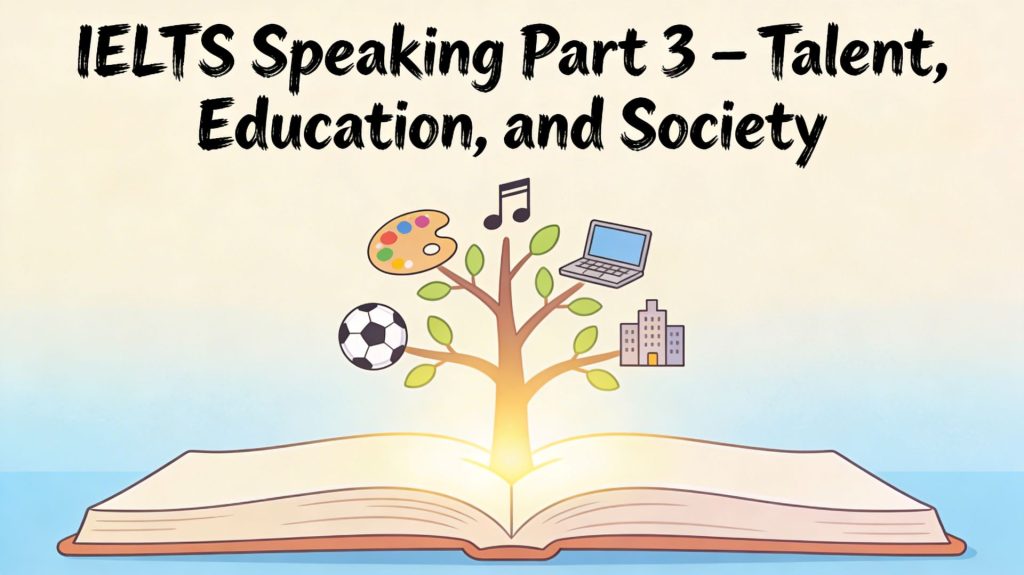
The model answers below are from a members-only video lesson
Watch the full video lesson here:
YouTube (Join): https://www.youtube.com/channel/UCFLYVgYCj1eAuM3YudWWDaA/join
Bilibili: https://space.bilibili.com/517168902
Speaker: Finn
Do you think everyone is born with a natural talent?
I think most people are born with certain natural inclinations, but not everyone recognizes them early on. Some people might show obvious talent in areas like music or sports, while others have strengths that are less visible, such as problem-solving or empathy. In my opinion, talent often starts as a small advantage rather than something extraordinary. Without practice or encouragement, it can easily go unnoticed. So yes, I believe everyone has potential, but whether it becomes a “talent” depends on development and opportunity.
How important is it for children to discover their talents at an early age?
I think discovering talent early can be helpful, but it’s not absolutely necessary. Early identification gives children more time to practice and build confidence in a particular area. However, I don’t think there should be too much pressure to find a special ability too soon. Some people discover what they’re good at much later in life and still become very successful. What matters more, in my opinion, is creating an environment where children feel free to explore different interests.
Should schools help students find and develop their natural talents?
Yes, I believe schools play a crucial role in this process. Students spend a large portion of their time at school, so teachers are in a good position to notice their strengths. Ideally, schools should offer a variety of subjects and extracurricular activities so students can experiment. At the same time, academic achievement shouldn’t be the only focus. If schools recognize different types of intelligence, students who aren’t traditionally “academic” can still feel valued.
Do parents play a bigger role than teachers in developing a child’s talent?
I would say parents often play a slightly bigger role because they influence a child from a very young age. Parents usually provide emotional support, resources, and encouragement outside of school. However, teachers can sometimes identify abilities that parents overlook. I think the best outcomes happen when both work together. If either side is too controlling or indifferent, it can limit a child’s growth.
What happens if a child’s talent is not encouraged?
If a talent isn’t encouraged, it may gradually fade due to lack of practice and confidence. A child might also start doubting their abilities if no one acknowledges them. In some cases, this could affect their self-esteem in the long term. However, I don’t think talent completely disappears; it can resurface later if the person revisits that interest. Still, early support definitely makes development easier and more sustainable.
Can hard work replace natural talent? Why or why not?
To some extent, yes. I believe hard work can compensate for a lack of natural ability in many fields. For example, someone who isn’t naturally athletic can still become quite skilled through consistent training. However, at the highest professional levels, natural talent often gives people a competitive edge. Ideally, success comes from a combination of both talent and effort. Without discipline, even the most talented individuals won’t reach their full potential.
Are some talents valued more than others in society?
Definitely. Society tends to value talents that generate income or prestige, such as business, technology, or professional sports. Meanwhile, abilities like caregiving or artistic expression may receive less recognition, even though they’re equally important. I think this reflects economic priorities rather than true social value. In reality, a balanced society needs a wide range of talents to function properly. Hopefully, attitudes will become more inclusive over time.
How can governments support talented individuals?
Governments can provide scholarships, grants, and specialized training programs. Financial support is especially important for students from disadvantaged backgrounds. They can also invest in public facilities like sports centers, music schools, and innovation hubs. Another important factor is equal access to education, so talent isn’t limited by income. In my opinion, creating opportunities is more effective than simply identifying talent.
Do you think technology helps people develop their talents more easily today?
Yes, absolutely. Technology gives people access to online courses, tutorials, and global communities. For example, someone interested in graphic design can learn from experts on platforms like YouTube or online academies. It also allows people to showcase their abilities through social media or personal websites. However, the abundance of information can sometimes feel overwhelming. Overall, though, I think technology has made skill development more accessible than ever before.
Is it better to focus on improving strengths or overcoming weaknesses?
Personally, I believe focusing on strengths is more effective in the long run. When people build on what they’re naturally good at, they tend to feel more motivated and confident. That said, ignoring weaknesses completely can create practical problems. I think it’s important to reach a basic level of competence in weaker areas, especially if they affect daily life or career prospects. But for long-term success and fulfillment, developing strengths usually brings greater rewards.
Leave a Reply