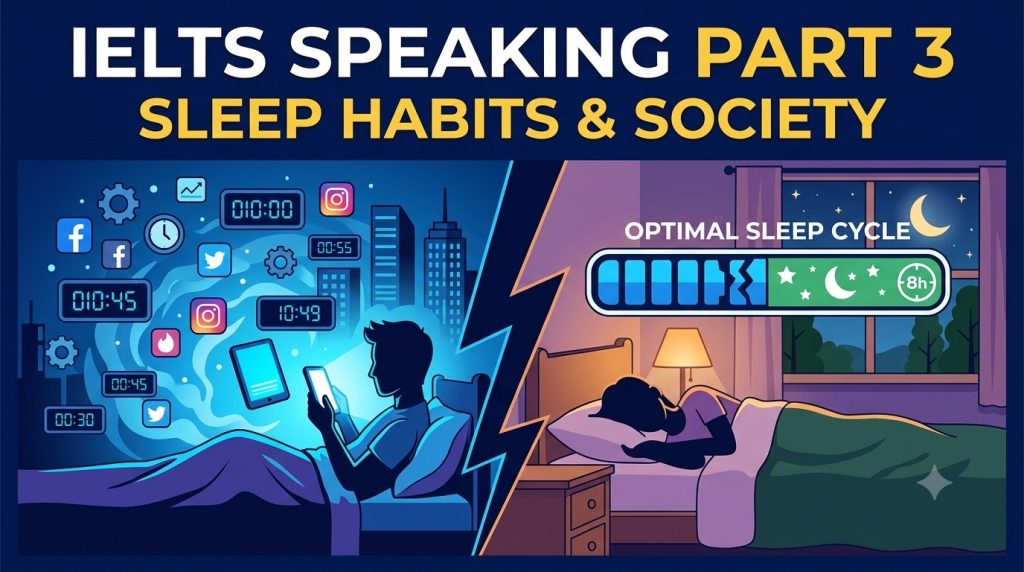
The model answers below are taken from a members-only video lesson.
Watch the full lesson:
Download the audio track and full transcript of the lesson here:
https://buymeacoffee.com/tracywang/extras
Speaker: Finn
How has the rise of digital technology affected the sleep quality of the general public?
To be honest, I think digital tech has absolutely wrecked our collective sleep schedules. The main issue is that almost all of us are glued to our screens right up until the moment we close our eyes, and that blue light just tricks the brain into thinking it’s still daytime. On top of that, there’s this bad habit people have now—I think it’s called ‘revenge bedtime procrastination’—where you just endlessly scroll through social media because you feel like you didn’t get enough free time during the day. So, what ends up happening is that we aren’t just sleeping fewer hours, but the sleep we do get is really restless. It’s pretty much turned into a massive, hidden public health issue where everyone is just perpetually exhausted.
Do you think the concept of a ’24-hour society’ has done more harm than good to human health?
That’s a really interesting question, and if I had to choose, I’d say it’s definitely done more harm than good. I mean, don’t get me wrong, it’s incredibly convenient to be able to order groceries at 2 AM or call a helpline at any hour, but our bodies just aren’t wired for it. We evolved to follow a natural day-and-night cycle, so forcing people to work crazy night shifts completely throws off their internal biological clock. Over time, that kind of disruption leads to serious physical problems, not to mention mental burnout and stress. So while our economies might thrive on being awake 24/7, I think we as humans are paying a pretty heavy price for it.
Why do you think young people today seem to get less sleep than previous generations?
I’d say it boils down to a mix of massive academic pressure and the fact that their social lives never actually switch off. If you look at students nowadays, the competition to get into good universities is just brutal, so they’re often staying up late studying or doing assignments. But even when they do finish their homework, they’re straight onto their phones because of this massive fear of missing out on whatever their friends are doing online. Older generations could just go home, lock the door, and that was the end of their social day, you know? But for kids today, that constant digital stimulation means their brains are running a mile a minute right up until bedtime.
What responsibilities do employers have regarding the sleep health and work hours of their staff?
I think employers actually have a huge role to play here, both ethically and for the sake of their own business. For one thing, managers really need to stop fostering this toxic culture where you’re expected to reply to work emails at nine or ten o’clock at night. There should be a hard line where your workday ends and your personal time begins, without any fear of penalization. Also, for jobs that involve heavy machinery or driving, putting strict caps on shift lengths is just basic safety. At the end of the day, well-rested employees are way more productive and make fewer mistakes, so it’s in the company’s best interest to protect their sleep.
Should schools shift their start times later in the morning to accommodate teenage sleep cycles?
Yeah, absolutely, I’m a big believer in this, and the science totally backs it up. Apparently, teenagers go through this biological shift where their bodies naturally want to stay up later and sleep in longer, so it’s not just them being lazy. Forcing a fifteen-year-old to sit in a math class at 7:30 in the morning is basically like asking them to function while jet-lagged. If schools could just push that first bell back by an hour or so, it would align much better with their actual biology. I’m certain we’d see a huge jump in their grades, and honestly, they’d probably be a lot less miserable to deal with in the mornings.
In what ways do sleep deprivation and fatigue impact a country’s economy or workforce productivity?
It’s actually massive when you look at the big picture. When people are exhausted, their brains just don’t fire on all cylinders, so simple tasks take twice as long and creative problem-solving pretty much goes out the window. In manual or medical jobs, being tired leads to costly mistakes and workplace accidents, which can derail a whole operation. Plus, chronic fatigue absolutely trashes your immune system, meaning companies have to deal with a lot of people calling in sick all the time. When you multiply those little drops in efficiency across millions of workers nationwide, it adds up to a staggering loss in overall economic output.
How do cultural attitudes toward public napping or afternoon rests vary around the world?
It’s funny how differently cultures view this, because it really shows what a society values. In some warmer climates, taking a midday break is deeply ingrained in the daily routine, and people see an afternoon rest as the most sensible way to beat the heat and recharge. But if you try doing that in a fast-paced Western corporate office, you’d probably be labeled as lazy or unmotivated. Then again, in some highly competitive societies, you actually see people nodding off on public trains or even during meetings. Over there, it’s not really seen as a bad thing; it’s almost respected because it proves the person has exhausted themselves working hard.
Do you believe governments should run public health campaigns to educate people about the importance of sleep?
I really do, yeah, because sleep always seems to get treated like an afterthought. Governments spend millions telling us to eat our vegetables and go to the gym, but they rarely talk about getting a solid eight hours. We live in this culture that almost glamorizes staying up late and working on a ‘grind schedule,’ which is just so unhealthy. A good public campaign could help break that mindset and give people practical tips on how to properly wind down at night. Since sleep issues are linked to long-term health problems like heart disease, it would actually save taxpayers a fortune in healthcare costs later on.
Leave a Reply